
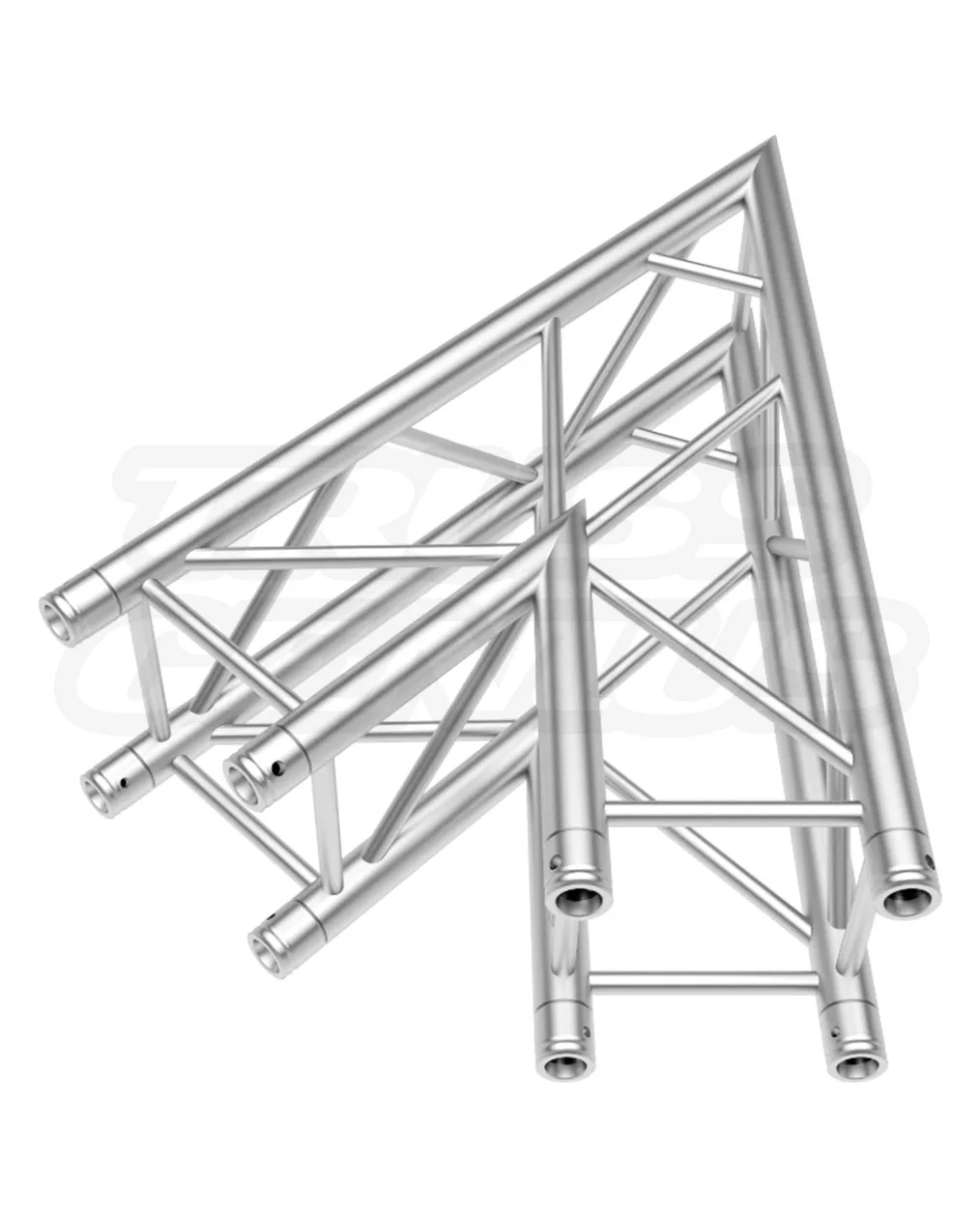
EVT290S-45DA | 45° Corner
$669.00 Original price was: $669.00.$446.00Current price is: $446.00.
EVT290S-45DA — 45-Degree Fixed 2-Way Corner Square Aluminum Truss
Dimensions
Overall Truss Length: 1.64 ft (0.5 m)
Overall Truss Width: 11.41 in (290 mm)
Angle: 45-Degrees
Construction
Material Type: Aluminum Alloy EN AW-6082 T6
Main Tubing: 1.96 in (50 mm) Outer Diameter with 0.08 in (2 mm) Wall Thickness
Brace Tubing: 0.78 in (20 mm) Diagonal Bracing with 0.08 in (2 mm) Wall Thickness
Finish & Features
Surface: Aluminum Brush Finish
Certification: TUV certified
Connection Type: Conical Connection System (Includes Couplers, Tapered Pins, and R-Clips)
Compatibility: Fits F34, EVT290S, and all standard 290mm Square Truss systems
Weight: 24 lb (10.88 kg)
In stock
EVT290S Truss Systems Knowledge Center
EVT290S-45DA 2-Way 45-Degree Corner.
A Fixed 45-Degree Corner for Defined Truss Turns and Direction Changes.
The EVT290S-45DA is a brushed-aluminum fixed 2-way, 45-degree corner for compatible F34, EVT290S, and matching 290 mm square truss systems. It joins two compatible truss sections at a fixed 45-degree angle when a truss structure requires a 45-degree turn rather than a straight connection or standard 90-degree corner.
Product Facts
45-Degree Corner Overview
A Fixed 45-Degree Corner for Compatible Square Truss Connections and Turns.
The EVT290S-45DA is a fixed 2-way, 45-degree corner for compatible 290 mm square aluminum truss systems. It provides the specified 45-degree connection where two truss sections must change direction by 45 degrees instead of continuing straight or meeting through a standard 90-degree corner.
What Does the 45-Degree Corner Do?
A Fixed 45-Degree Connection for F34 Square Truss Structures and Turns.
The EVT290S-45DA provides the fixed 45-degree corner used for F34 and compatible 290 mm square-truss systems when a 45-degree turn is required. Its angle is built into the component and is not field adjustable. Select this corner when the required connection is neither straight nor a conventional 90-degree turn.
Where Is This 45-Degree Corner Used?
For Trade Shows, Events, Motion Capture, AV, and Custom Truss Solutions.
The EVT290S-45DA is used in compatible 290 mm square-truss structures when the design calls for a fixed 45-degree turn between truss sections. Typical applications include trade-show truss structures, event and production structures, motion-capture systems, AV installations, and custom truss solutions. The component’s role is to provide the specified 45-degree connection; suitability for the completed structure depends on the full plan, connected components, supports, loads, hardware, and applicable review.
Why Choose Brushed Aluminum?
Choose a Natural-Metal Finish for a Coordinated Truss Appearance.
Choose the EVT290S-45DA when the fixed-angle corner must match brushed-aluminum truss components or when a natural-metal appearance is preferred in a trade show, event, AV, production, or display environment. Brushed aluminum is a finish choice; it does not alter the component’s connection requirements, inspection requirements, or project-specific engineering needs.
Included Connection Hardware
Hardware for One Connecting Side Only.
Included connection hardware is supplied for one connecting side of the EVT290S-45DA. The 2-way configuration does not mean hardware is included for both available connection directions. Confirm the current product package, project drawing, and connection schedule for the exact supplied hardware and for any additional compatible hardware required.
Technical Reference
EVT290S-45DA Specifications.
These values identify the EVT290S-45DA product. Confirm current manufacturer drawings, instructions, connection hardware, component condition, and technical documentation before ordering or assembling a compatible system.
Identification
Product Details
Overall Size
Dimensions
Construction
Material and Finish
Connections
System Interface
System Compatibility
F34, EVT290S, and Compatible 290 mm Square Truss Systems.
The EVT290S-45DA has 290 mm square-truss geometry, 50 mm main chords, and conical connection receivers. It is intended for compatible F34, EVT290S, and standard 290 mm square-truss systems with matching receiver spacing and conical interface geometry. Confirm actual receiver geometry, full conical seating, pin engagement, component condition, and manufacturer or engineering data before combining separately sourced or mixed-brand components.
How Is the 45-Degree Corner Connected?
Plan the Connection, Then Inspect Every Required Point.
Assembly should be completed by trained personnel using compatible components, the project drawing, the approved support or rigging plan, and sufficient hardware for every required connection. The supplied hardware covers one connecting side only.
Safety and Engineering
A Fixed 45-Degree Corner Is Not a Standalone Load, Span, or Structure Rating.
The EVT290S-45DA does not independently establish a span, load, wind, suspension, freestanding-structure, or public-facing structure rating. Determine suitability from the complete configuration, including connected components, spans, orientation, supports, connection hardware, bracing, rigging method, applied loads, lighting, AV equipment, displays, signage, base plates, ballast or anchorage, environmental conditions, venue requirements, and applicable approvals.
Product Questions
EVT290S-45DA Frequently Asked Questions.
What is the EVT290S-45DA?
The EVT290S-45DA is a fixed 45-degree 2-way aluminum corner with a brushed aluminum finish for compatible 290 mm square conical truss systems.
What hardware is included?
One hardware set is supplied for one connecting side: 4 conical couplers, 8 coupler-pins, and 8 r-clips. Confirm the current package and connection schedule for any additional compatible hardware required.
What truss systems are compatible?
It fits F34, EVT290S, and standard 290 mm square truss systems when receiver spacing, conical interface dimensions, and all other relevant dimensions match. Mixed-brand fit should be verified before use.
Is the 45-degree angle adjustable?
No. The 45-degree relationship is determined by the physical configuration of the component and is not field adjustable.
Need a Fixed 45-Degree F34 Truss Corner?
The EVT290S-45DA provides a fixed 45-degree connection for compatible 290 mm square-truss structures, including trade shows, event and production structures, motion-capture systems, AV installations, and custom truss solutions. The brushed aluminum finish suits structures where a natural-metal truss appearance is preferred.
Structural Solutions, Unmatched Innovation