
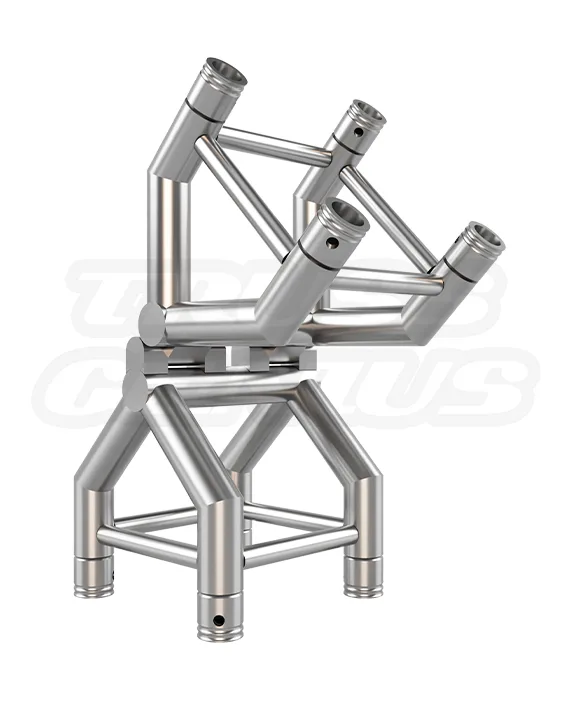
EVT290S-Hinge
$835.00 Original price was: $835.00.$556.00Current price is: $556.00.
EVT290S Hinge — 0 to 180-Degree 2-Way Rotatable Pivot Hinge Square Aluminum Truss
Dimensions
Overall Truss Length: 0.85 ft (0.26 m)
Overall Truss Width: 11.41 in (290 mm)
Range of Motion: 0 to 180 Degrees
Construction
Material Type: Aluminum Alloy EN AW-6082 T6
Main Tubing: 1.96 in (50 mm) Outer Diameter with 0.11 in (3 mm) Wall Thickness
Brace Tubing: 0.78 in (20 mm) Diagonal Bracing with 0.08 in (2 mm) Wall Thickness
Finish & Features
Surface: Aluminum Brush Finish
Certification: TUV certified
Connection Type: Conical Connection System (Includes Couplers, Tapered Pins, and R-Clips)
Compatibility: Fits F34, EVT290S, and all standard 290mm Square Truss systems
Weight: 18 lb (8.16 kg)
In stock
EVT290S Adjustable Hinge Knowledge Center
EVT290S-Hinge 0–180-Degree Rotatable 2-Way Truss Hinge.
An Adjustable 290 mm Aluminum Pivot Component for Specified Connection Angles and Custom Truss-System Configurations.
The EVT290S-Hinge is a 2-way adjustable pivot component for compatible 290 mm square aluminum truss systems. Unlike a fixed-angle corner, the hinge allows the selected connection angle and component orientation between two connected truss sections to be adjusted through a nominal range of 0 to 180 degrees. It is manufactured from EN AW-6082 T6 aluminum and uses 50 mm main tubing with a 3 mm wall thickness together with 20 mm diagonal bracing with a 2 mm wall thickness.
Product Facts
Product Overview
An Adjustable Connection Angle Instead of a Single Fixed Angle.
The primary functional difference between the EVT290S-Hinge and a conventional truss corner is adjustability. A fixed-angle component defines one relationship between connected truss sections. The hinge allows the selected connection angle and component orientation to vary within its stated 0 to 180-degree range, giving the approved truss system an adjustable connection where a fixed corner would not match the specified requirements.
Common Applications
Adjustable Connections for Specified Truss-System Configurations.
The EVT290S-Hinge is most useful when the required connection angle is variable, site-dependent, non-standard, or intentionally adjusted during the planning or assembly process. Select the hinge only where the complete approved truss system accounts for its selected angle, supports, spans, loads, bracing, connection hardware, and intended use.
Who It’s For
For Professionals Who Need More Connection-Angle Control Than a Fixed Corner Can Provide.
The EVT290S-Hinge is intended for professional applications where the desired connection angle is not known until system design, where multiple specified angle positions are required, or where a fixed-angle corner would unnecessarily restrict the approved truss system.
Included Connection Hardware
One Hardware Set for One Connecting Side Only.
The EVT290S-Hinge includes one set of compatible conical connection hardware for one connecting side only. The 2-way hinge configuration provides two truss connection directions, but included hardware does not cover both sides. Additional compatible connecting hardware is required for the remaining truss connection. Confirm the current product package, approved truss system, and connection schedule before assembly.
Technical Reference
EVT290S-Hinge Specifications.
The following values identify the hinge range of motion, material, tubing, finish, connection system, certification, compatibility, dimensions, and nominal weight. Confirm current manufacturer drawings, instructions, connection hardware, component condition, and technical documentation before ordering or assembling a compatible system.
Identification
Product Details
Construction
Tubing and Material
Connection System
Hardware and Certification
Compatibility
System Fit
System Compatibility
EVT290S, F34, and Compatible 290 mm Square Truss Systems.
The EVT290S-Hinge is designed around a nominal 290 mm square profile and 50 mm main tubing. Compatibility with another truss component requires more than matching the nominal outside dimensions. Receiver position, conical connector details, chord spacing, component orientation, and applicable structural data must also correspond.
Assembly Overview
Set the Required Connection Angle Before the Truss System Is Placed Under Load.
The defining characteristic of the EVT290S-Hinge is its adjustable connection angle. That flexibility also means the selected angle and component orientation should be established as part of the assembly process. The selected hinge angle affects the connected truss sections, support arrangement, and load path of the complete truss system.
Safety and Engineering
An Adjustable Connection Angle Changes the Complete Truss System.
The structural behavior of an adjustable hinge cannot be defined by the 0–180-degree movement range alone. Changing the selected hinge angle changes the relationship between connected truss sections and can alter spans, support reactions, load direction, component forces, and the behavior of the complete truss system.
Product Questions
EVT290S-Hinge Frequently Asked Questions.
When should I select the EVT290S-Hinge instead of a fixed-angle corner?
Select the hinge when the approved truss system requires an adjustable connection angle or when the specified angle is not available from a fixed-angle corner. Select a fixed-angle corner when the required connection angle is known and remains unchanged.
Can the hinge be adjusted after the truss system has been loaded?
Do not treat the 0–180-degree movement range as authorization to reposition the hinge under load. Establish the selected hinge angle during controlled assembly before the truss system is lifted, supported, or subjected to its intended loading condition, unless a project-specific engineered procedure establishes otherwise.
Does the hinge have the same capacity at every selected angle?
Do not assume so. The selected hinge angle can change the complete truss system’s span relationships, support reactions, load paths, and component forces. Evaluate suitability for the actual approved truss system and intended loading condition.
Can the hinge be combined with another 290 mm square-truss system?
Confirm receiver positions, conical connection details, chord spacing, component orientation, compatible hardware, system load data, and applicable engineering requirements before combining components. A physical connection alone does not establish structural equivalence.
Building an EVT290S Truss System with an Adjustable Connection Angle?
Contact us for hinge selection, compatible truss sections, specified connection-angle review, connection verification, junctions, fixed-angle alternatives, base plates, engineering coordination, custom truss-system design, and freight assistance.
Structural Solutions, Unmatched Innovation