Product Knowledge Center
EVT220T-Alpine 10x10 Triangular Aluminum Truss Booth
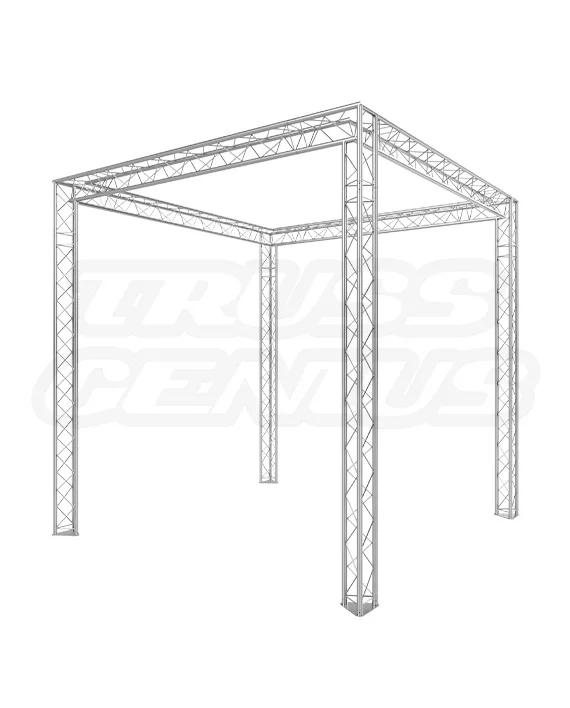
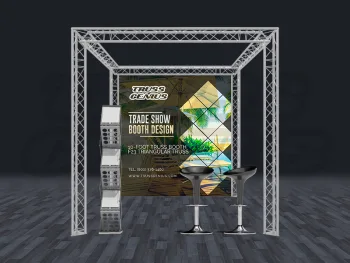
The EVT220T-Alpine is a modular 10x10 exhibit booth built from the EVT220T 220mm triangular aluminum truss series. Its three-chord profile creates distinctive angular lines that give trade show exhibits, branded activations, retail displays, and production environments a lighter, more architectural appearance than a conventional square truss grid.
Manufactured from EN AW-6082 T6 aluminum alloy with a brushed aluminum finish, the Alpine creates an approximately 9.84 ft wide × 9.84 ft deep × 9.84 ft high ground-supported exhibit structure. Its modular conical connection system supports efficient assembly, disassembly, transportation, and future reconfiguration.
Designed for Trade Shows and Branded Environments
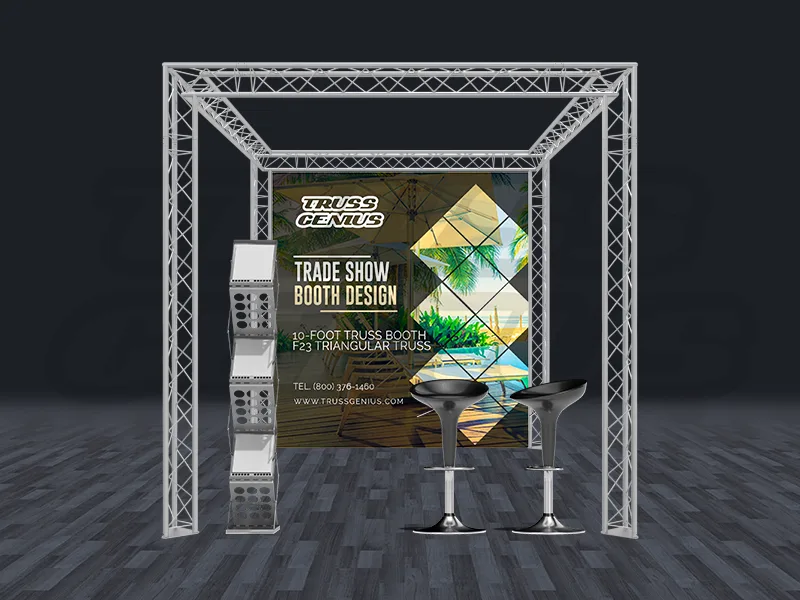
The EVT220T-Alpine defines a professional exhibit area without visually overpowering the products, graphics, or people inside it. Its triangular profile creates a distinctive geometric presentation while preserving an open layout for branding, monitors, lighting, banners, signage, and product displays.
Recommended applications include:
- 10x10 trade show exhibits
- Branded promotional activations
- Retail and showroom displays
- Gaming, esports, and technology events
- DJ and mobile production booths
- Product demonstration areas
- Photography and video environments
- Temporary exhibit and signage structures
Who It’s For
- Trade show exhibitors: Brands that want a clean overhead structure for graphics, signage, monitors, lighting, and product presentation without using a heavier square truss grid.
- Mobile entertainment and event production companies: DJs, production teams, and event operators who need a lightweight modular booth that can be transported, assembled, dismantled, and reconfigured efficiently.
- Food, beverage, and promotional brands: Pop-up teams that want a more substantial and architecturally defined structure for festivals, tastings, product launches, outdoor activations, and temporary retail environments.
- Gaming, esports, and technology brands: Event teams that need a geometric framework for monitors, branded graphics, product demonstrations, streaming environments, and convention activations.
- Retail and showroom designers: Designers who need to define a branded area within a store, showroom, or seasonal display while maintaining an open and contemporary appearance.
- Photography and video teams: Production teams that need a modular structure for temporary sets, backdrops, product shoots, lighting positions, and branded media environments.
Modular Expansion and Reconfiguration
The EVT220T-Alpine is assembled from standard EVT220T Series components. Individual sections can be reused, replaced, or combined with compatible components as exhibit and production requirements change.
- Modify the footprint: Compatible straight sections may be added or exchanged to create wider or deeper layouts.
- Adjust the height: Alternate straight-section combinations may be used when a different overall height is required.
- Create larger exhibits: EVT220T components can be used to develop expanded booth layouts, entrance structures, display walls, and other temporary configurations.
- Reuse your inventory: Individual sections may be incorporated into future EVT220T structures instead of remaining dedicated to a single booth.
- Replace individual components: Additional truss sections, corners, bases, and connection hardware are available separately.
Browse compatible components in the EVT220T Triangular Aluminum Truss Collection.
Triangular Truss Design
The EVT220T Series uses three main chords arranged in a triangular profile. This creates a lighter visual appearance and more distinctive angular geometry than a conventional four-chord square truss system.
The triangular form can contribute differently to the finished presentation depending on how the approved components and corners are positioned. Component orientation must remain consistent with the intended connection geometry, loading plan, and installation requirements.
Assembly and Connection System
The EVT220T-Alpine uses conical couplers, tapered pins, and safety clips to create secure, repeatable connections between the individual truss sections.
- Lay out all components on a clean and level surface.
- Inspect the truss sections, corners, bases, couplers, pins, and safety clips.
- Assemble the upper booth frame at floor level whenever the installation plan permits.
- Insert each conical coupler fully into the corresponding truss receiver.
- Align the connector holes and install the tapered pins.
- Secure every pin using the appropriate safety clip.
- Confirm that all connections are completely seated before raising or loading the structure.
A suitable hammer may be used to seat and remove the tapered pins. Assembly should be completed only by personnel familiar with aluminum truss systems, safe lifting practices, and the intended booth configuration.
Loading and Attachment Requirements
The allowable loading of the EVT220T-Alpine depends on the exact span, support conditions, truss orientation, attachment points, load distribution, and complete booth configuration. A single pounds-per-foot value should not be applied universally to every installation.
- Do not exceed the published capacity of any truss section, corner, connector, base, or attached component.
- Loads must be distributed appropriately between the structural chords.
- Do not place concentrated loads directly on connection points or corner joints unless specifically approved.
- Do not attach equipment to diagonal bracing unless the component is expressly designed and rated for that purpose.
- All signs, monitors, lighting fixtures, graphics, and accessories must use appropriately rated attachment hardware.
- Do not assume that changing the dimensions preserves the capacity of the original configuration.
- Review the complete system whenever equipment, graphics, dimensions, orientation, or support conditions change.
Stability, Ballast, and Environmental Conditions
- Install the booth only on a stable and level surface.
- Confirm that all base components remain flat and fully supported.
- Ballast, anchoring, or both may be required based on the complete installation.
- Banners, fabric, graphic panels, monitors, screens, and signs may create significant lateral forces.
- Do not move or reposition the booth while equipment or graphics remain attached.
- Outdoor installations require site-specific engineering, appropriate anchoring or ballast, and active weather monitoring.
- The structure must be taken out of service during unsafe wind or weather conditions.
Inspection and Component Care
- Inspect every truss section and connection component before each use.
- Check the main chords for dents, bends, cracks, scoring, or other deformation.
- Inspect diagonal braces and welds for cracking, separation, or impact damage.
- Remove damaged truss sections, couplers, pins, clips, corners, and bases from service immediately.
- Keep connection surfaces clean and free from dirt, metal fragments, and debris.
- Handle all sections carefully to avoid denting or deforming the main chords.
- Do not drill, weld, grind, straighten, or otherwise alter structural components without written engineering approval.
Why Purchase the EVT220T-Alpine from Truss Genius?
- Booth planning assistance: Help selecting the components needed for a complete exhibit configuration.
- Expansion guidance: Support planning larger or alternate layouts using compatible EVT220T components.
- Component identification: Assistance locating replacement truss sections, corners, bases, and connecting hardware.
- CAD and technical resources: Product drawings and available technical documentation for planning purposes.
- Application experience: Practical support for trade show, retail, event, production, and branded display projects.
Frequently Asked Questions
What is the EVT220T-Alpine intended for?
The EVT220T-Alpine is intended primarily for temporary trade show, retail, promotional, production, photography, and branded display applications requiring a lightweight, ground-supported truss booth.
How is triangular truss different from square truss?
Triangular truss uses three main chords rather than four. It creates a lighter visual profile and more distinctive angular geometry, while square truss produces a more conventional box-grid appearance.
Can the Alpine booth be expanded beyond 10x10?
Yes. Compatible EVT220T straight sections may be added or exchanged to create alternate dimensions. Any revised layout should be reviewed for loading, stability, ballast, connection orientation, and support conditions.
Can monitors, lighting, banners, or graphics be added?
Yes. Appropriately selected exhibit elements may be integrated into the structure, provided the complete loading plan, attachment method, support conditions, and booth configuration remain within the applicable limits.
Can the EVT220T-Alpine be used outdoors?
Outdoor use requires site-specific engineering, proper anchoring or ballast, evaluation of all attached surfaces, and continuous weather monitoring. The structure must not remain in service during unsafe wind or weather conditions.
Are replacement or expansion components available?
Yes. Individual EVT220T straight sections, corners, bases, connecting hardware, and related components may be purchased separately to replace parts or create alternate configurations.
Technical Resources and Project Support
Contact Truss Genius for product drawings, component identification, CAD files, available load documentation, replacement hardware, or assistance planning a custom EVT220T booth configuration.
Disclaimer and guidance statement: The purchase of this product does not approve or authorize a specific installation or use. A qualified professional should review the complete structure, loading plan, attachment methods, ballast, anchoring, venue conditions, environmental forces, and intended application whenever engineering review is required. Product specifications and technical information are provided as general guidance and may be updated without notice. Truss Genius Worldwide, LLC disclaims liability for errors, omissions, improper assembly, unauthorized modifications, or uses that have not been evaluated for the specific installation.


